 Veräinsbuch
Treasurer’s report template: the club’s financial report for the AGM
Once a year the treasurer stands in front of the general meeting and explains where the club’s money came from and where it went. A clear treasurer’s report builds trust, makes the auditors’ job easier and leads to a quick discharge of the committee. Below you will find a complete treasurer’s report template to copy, an explanation of each part, a checklist for the weeks before the AGM and the most common mistakes. It is written for small clubs that keep a simple cash book, not for full double-entry accounting.
Published · David Bohler
Try free for 14 daysNo credit card needed · ready in 2 minutes
What a treasurer’s report needs to show
Members are not accountants. They want to understand three things: how much money the club had at the start of the year, what happened during the year, and how much is left. Everything else is detail that supports those three answers. A good treasurer’s report contains:
- The financial year it covers, with start and end date.
- The opening balance, split by account: bank, savings, cash.
- Income and expenses, grouped in a way members understand, for example by event.
- The result of the year: surplus or deficit.
- The closing balance per account, matching the bank statements and the counted cash.
- Open items: unpaid invoices, money still to come in, reserves for planned projects.
- The confirmation of the auditors (account examiners).
Treasurer’s report template (copy and adapt)
Copy this template and fill in the amounts from your cash book. Replace the example events with your own and delete lines you don’t need. Check that the closing balance equals the opening balance plus income minus expenses.
[CLUB NAME]

Treasurer’s Report for the Financial Year [year]
([start date] to [end date])

Presented to the Annual General Meeting on [date] by [name], Treasurer

1. Opening balance on [start date]
Bank account [bank, last 4 digits]:   [amount]
Savings account:                     [amount]
Cash:                                [amount]
Total opening balance:               [amount]

2. Income
Membership fees:                     [amount]
Summer party [date]:                 [amount]
Christmas market [date]:             [amount]
[Other event]:                       [amount]
Donations and sponsorship:           [amount]
Grants / subsidies:                  [amount]
Other income:                        [amount]
Total income:                        [amount]

3. Expenses
Summer party [date]:                 [amount]
Christmas market [date]:             [amount]
[Other event]:                       [amount]
Insurance:                           [amount]
Equipment and material:              [amount]
Rent / clubhouse:                    [amount]
Bank fees:                           [amount]
Other expenses:                      [amount]
Total expenses:                      [amount]

4. Result per event
Event               Income      Expenses    Result
Summer party        [amount]    [amount]    [amount]
Christmas market    [amount]    [amount]    [amount]
[Other event]       [amount]    [amount]    [amount]

5. Result of the year
Total income – total expenses = [surplus / deficit] of [amount]

6. Closing balance on [end date]
Bank account:                        [amount]
Savings account:                     [amount]
Cash (counted on [date]):            [amount]
Total closing balance:               [amount]

Check: opening balance [amount] + income [amount] – expenses [amount] = closing balance [amount]

7. Open items and reserves
Unpaid invoices: [description, amount]
Money still to receive: [description, amount]
Reserved for: [project, amount]

8. Comments
[Main reasons for changes compared with last year, larger one-off expenses, outlook for next year.]

9. Auditors’ confirmation
We, the undersigned auditors elected by the general meeting of [date], checked the cash book, receipts, bank statements and cash on [date]. [We found the accounts complete and in order. / We have the following remarks: [describe].] We recommend that the general meeting approve the accounts and discharge the committee.

[Place], [date]

______________________          ______________________
[Name], Auditor                    [Name], Auditor

______________________
[Name], Treasurer
Income and expenses by event: why it helps
For most small clubs, events are the main source of income: the summer party, the Christmas market, the quiz night. Members want to know whether each event was worth the effort. If you assign every income and expense to an event during the year, the result per event is ready at the AGM without extra work. It also helps the committee decide which events to repeat, and it makes questions such as “did the barbecue make a loss?” easy to answer.
Costs that don’t belong to one event, such as insurance, bank fees or equipment, go into general categories. Keep the number of categories small; ten clear lines are easier to read than forty.
Bank and cash: making the closing balance match
The closing balance is where most treasurer’s reports go wrong. Before the AGM, compare every account separately: the bank balance in the cash book must equal the balance on the bank statement on the last day of the financial year, and the cash balance must equal the money actually counted in the cash box. Count the cash with a second person and write down the result with the date.
Transfers between bank and cash, for example when you deposit the takings of an event, are neither income nor expense. Record them as transfers between accounts, otherwise income is counted twice.
Working with the auditors
Many clubs elect two members as auditors (account examiners) who check the treasurer’s work before the AGM. Agree a date with them early, at least two weeks before the meeting, and give them everything at once: the cash book, all receipts numbered in the same order, the bank statements for the whole year and the cash count. The auditors’ report usually confirms that the accounts are complete and recommends the discharge of the committee. If they have remarks, sort them out before the AGM where possible, and mention them openly in the report.
Checklist: treasurer’s report in the weeks before the AGM
- Book all receipts and bank movements up to the last day of the financial year.
- Chase missing receipts and open reimbursements.
- Count the cash and note the amount, date and both names.
- Compare each account with the bank statement and the cash count.
- Check that every income and expense is assigned to the right event or category.
- Prepare the report with the template above and a short comment.
- Hand everything to the auditors and agree a check date.
- Bring printed copies or a PDF for members who want to read along.
Common mistakes in treasurer’s reports
- The closing balance does not match the bank statement or the counted cash.
- Transfers between bank and cash counted as income or expense.
- Receipts missing for expenses, especially small cash purchases.
- Too much detail: forty categories that nobody in the room understands.
- No comparison or comment, so members can’t see why the result changed.
- Event takings booked without the corresponding expenses.
- Auditors receive the documents the evening before the meeting.
How Veräinsbuch helps the treasurer
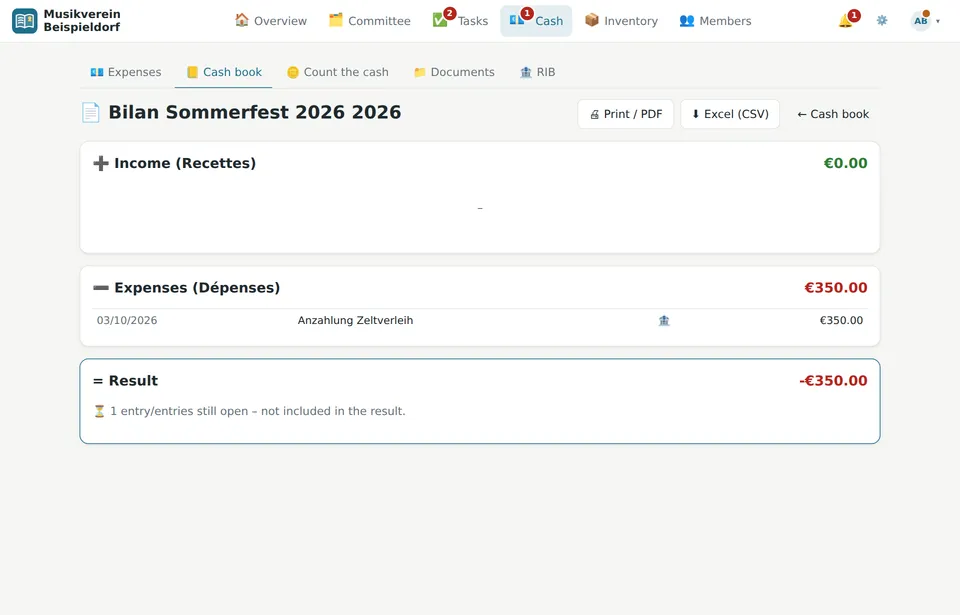
With the Pro plan, Veräinsbuch keeps the cash book for each financial year with separate accounts such as bank, savings, cash and Payconiq. Receipts are photographed and attached to the booking, the amount is recognised automatically, and members can submit their own expenses for the treasurer to approve and mark as paid. Bank statements can be imported, and every booking can be assigned to an event, so the balance per event is ready when you need it.
Before and after an event you count the float and the takings in the app, and the result is booked automatically. At the end of the year you print the cash book as a summary or in detail with accounts and closing balance, and export it as PDF or CSV for the auditors. Veräinsbuch is a cash book for small clubs, not double-entry accounting or tax software, but for a clear treasurer’s report it is usually all you need.
What it costs
The cash tools are part of the Pro plan at €14.95 per month per club, regardless of the number of members. It includes everything in Basis (€9.95 per month), such as tasks, minutes, events, polls, inventory and members. The 14-day trial includes all features, needs no credit card, and you can cancel monthly.
Simple pricing
Per club, no matter how many members. Cancel any month.
Basis · 9,95 € / month
- Tasks & reminders
- Meeting minutes
- Events & polls
- Inventory
- Members, helpers & contacts
- Push, offline, 5 languages
- 500 MB storage included
Pro · 14,95 € / month
- Everything in Basis
- Cash & expenses with receipt scan
- Cash book & balance per event
- Bank statement import
- Cash count & payment proofs
- 1 GB storage included
Everything is unlocked during the 14-day trial. Then choose Basis or Pro – or simply stop. More storage if needed: +5 GB for €1.95 a month.
Frequently asked questions
What should a treasurer’s report include?
The opening balance, income and expenses for the year, the result, the closing balance per account, any open items and the auditors’ confirmation. Grouping income and expenses by event makes it much easier for members to understand.
How long should the treasurer’s report be?
For a small club, one or two pages are usually enough. Present the main figures at the meeting and keep the detailed cash book available for anyone who wants to check it.
Do we need auditors for our club?
Many constitutions require the general meeting to elect auditors or account examiners. Check your rules. Even where it is not required, an independent check builds trust and protects the treasurer.
What if the closing balance doesn’t match the bank statement?
Look for missing bank movements, transfers between bank and cash booked as income or expense, and typing errors. Compare month by month until you find the difference, and explain any remaining difference openly.
Is this template suitable for double-entry accounting?
No. This template is for clubs that keep a simple cash book with income and expenses. Larger organisations with double-entry bookkeeping or legal reporting duties may need a different format; ask for advice if unsure.
Can Veräinsbuch produce the figures for the treasurer’s report?
With the Pro plan, yes: the cash book shows accounts, closing balance and the balance per event, and you can print it or export it as PDF or CSV. You then copy the totals into your report.