 Veräinsbuch
AGM minutes template: sample minutes of a club’s annual general meeting
The minutes of the annual general meeting are the club’s official memory. They show who was there, whether the meeting could take decisions, which accounts were approved, whether the committee was discharged and who was elected. Banks, local authorities and future committees may ask for them. Below you will find a complete AGM minutes template to copy, tips for taking minutes during the meeting, and the mistakes that cause trouble later. Your constitution or rules decide the details, so adapt the template to them.
Published · David Bohler
Try free for 14 daysNo credit card needed · ready in 2 minutes
Why AGM minutes matter more than committee minutes
Committee minutes help the committee get things done. AGM minutes are different: they document decisions of the members as a whole, such as the election of the committee, the approval of the accounts or a change to the constitution. When a new chair needs to prove to the bank that they may sign, or when someone later asks whether a rule change was properly approved, the AGM minutes are the document everyone looks for.
That is why AGM minutes should be complete, precise about votes and signed, and they should be stored where the next committee can find them.
What AGM minutes must contain
- Club name, type of meeting (ordinary or extraordinary), date, place, start and end time.
- Chair of the meeting and minute-taker, and any vote counters (tellers).
- Attendance: number of members present, number of proxies, attendance list attached.
- Confirmation that the meeting was properly called and whether it was quorate.
- A short summary of each report: chair, treasurer, auditors.
- Every decision in clear words, with the vote: for, against, abstentions.
- Election results with names, positions and terms of office.
- Signatures of the chair and the minute-taker, as required by your rules.
AGM minutes template (copy and adapt)
This template follows the usual order of an annual general meeting. Replace everything in [square brackets] and delete what doesn’t apply. Record decisions and results, not every word that was said.
[CLUB NAME]

Minutes of the Annual General Meeting [year]

Date: [date]
Place: [venue, address]
Start: [time]    End: [time]
Chair of the meeting: [name, position]
Minute-taker: [name]
Vote counters: [names]

1. Opening and welcome
The chair opened the meeting at [time] and welcomed the members and guests [names of guests, if any].

2. Attendance, notice and quorum
Present: [number] members entitled to vote, plus [number] valid proxies, total [number] votes. The attendance list is attached to these minutes.
Apologies: [names or number].
The chair confirmed that the meeting was called on [date] by [e-mail / letter / notice] in accordance with Article [x] of the constitution. The meeting [is / is not] quorate.

3. Approval of the agenda
The agenda as sent with the invitation was approved [unanimously / with changes: [describe]].

4. Minutes of the last general meeting
The minutes of the general meeting of [date] were approved. For: [x], against: [x], abstentions: [x].

5. Annual report of the chair / secretary
[Name] presented the annual report for [year]: [main activities, events, membership numbers, important developments]. Questions: [summary or “none”].

6. Treasurer’s report
[Name], treasurer, presented the accounts for the financial year [year]:
Opening balance on [date]: [amount]
Total income: [amount]
Total expenses: [amount]
Result of the year: [amount]
Closing balance on [date]: [amount] (bank: [amount], cash: [amount])
Questions: [summary or “none”].

7. Auditors’ report
[Names], auditors, checked the accounts on [date]. They reported that [the cash book, receipts and bank statements were complete and in order / the following remarks: [describe]]. They recommended that the accounts be approved and the committee discharged.

8. Approval of the accounts and discharge of the committee
The accounts for [year] were approved. For: [x], against: [x], abstentions: [x].
The committee was discharged for the financial year [year]. For: [x], against: [x], abstentions: [x]. [Committee members did not vote on their own discharge.]

9. Membership fee and budget
The membership fee for [year] was set at [amount]. For: [x], against: [x], abstentions: [x].
The budget for [year] was presented [and approved: for [x], against [x], abstentions [x]].

10. Elections
The following seats were up for election: [positions / number of seats].
Candidates: [names].
Voting method: [show of hands / secret ballot].
Results:
[Name]: [x] votes – elected as [position] for [term]
[Name]: [x] votes – elected as [position] for [term]
[Name]: [x] votes – not elected
All elected candidates accepted their election.
Auditors for [year]: [names], elected [unanimously / with [x] votes].

11. Proposals
Proposal [number / title] by [name]: [short description].
Decision: [approved / rejected]. For: [x], against: [x], abstentions: [x]. [Required majority: [x]]

12. Activity programme
[Main events and projects for the coming year.]

13. Any other business
[Topics raised, for information only.]

The chair closed the meeting at [time].

[Place], [date]

______________________          ______________________
[Name], Chair of the meeting       [Name], Minute-taker

Attachments: attendance list, proxies, treasurer’s report, auditors’ report, [other]
Quorum, proxies and votes: how to record them
The quorum is the minimum number of members needed for the meeting to take valid decisions, if your constitution sets one. Count it at the start, after the attendance list has been signed, and write the number into the minutes together with the number of proxies. If people arrive or leave during the meeting and important votes follow, note the new number before the vote.
For every vote, write the result as for, against and abstentions, not just “approved”. For rule changes or the dissolution of the club, many constitutions require a special majority; write down which majority was needed and whether it was reached. For secret ballots, record the number of ballot papers, invalid papers and the votes per candidate.
Discharge of the committee: what to write
With the discharge, the general meeting confirms that it accepts how the committee managed the club during the past year, usually on the basis of the treasurer’s report and the auditors’ report. In the minutes, the discharge should be a separate decision with its own vote, after the approval of the accounts. If committee members do not vote on their own discharge, note that too. If the auditors had remarks, record them and what the meeting decided.
Practical tips for the minute-taker
- Prepare the minutes in advance using the agenda, so you only fill in results.
- Sit next to the chair so you can ask for vote results immediately.
- Ask the treasurer for the figures in writing, rather than noting them by ear.
- Read out important decisions before moving on, so nobody disputes them later.
- Note names of people who take on tasks and the deadlines.
- Write the final version within a few days, while everything is fresh.
- Collect signatures and keep the original together with the attendance list.
Common mistakes in AGM minutes
- No attendance figures, so nobody can prove the meeting was quorate.
- Votes recorded only as “approved” without the numbers.
- The discharge of the committee is missing or merged with the accounts.
- Election results without positions and terms of office.
- Rule changes without the exact new wording attached.
- Unsigned minutes, or minutes that are never shared with the members.
- Minutes stored on one person’s laptop and lost when the committee changes.
After the meeting: approval, sharing and storage
Depending on your rules, AGM minutes are signed by the chair and the minute-taker, approved by the committee or approved at the next general meeting. Share them with the members in a reasonable time, and send copies wherever they are needed, for example to the bank when the people authorised to sign change. Keep the original with the attendance list, the proxies and the reports, ideally in a place the whole committee can access.
How Veräinsbuch helps with AGM minutes
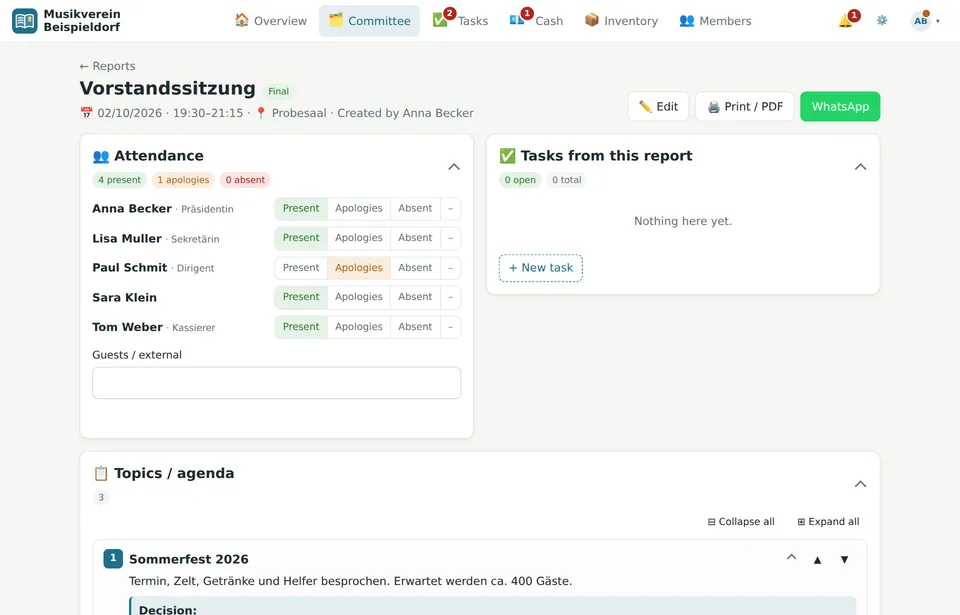
In Veräinsbuch, the minutes follow a fixed structure: you prepare the agenda in advance, tick the attendance list (present, excused, absent) and record a decision for each item. Action points from the meeting become tasks with a responsible person, a due date and reminders. The finished minutes can be printed or shared as a PDF, and they stay in the club’s account for the next committee.
You can also store the constitution and other official documents with their date. With the Pro plan, the figures for the treasurer’s report come straight from the cash book, so the numbers in the minutes match the accounts. Veräinsbuch does not decide legal questions for you: quorum, majorities and signatures still follow your constitution.
What it costs
Minutes, tasks, events and polls are included in the Basis plan at €9.95 per month per club, not per member. Pro at €14.95 per month adds the cash book and treasurer tools. Try everything free for 14 days, without a credit card, and cancel monthly.
Simple pricing
Per club, no matter how many members. Cancel any month.
Basis · 9,95 € / month
- Tasks & reminders
- Meeting minutes
- Events & polls
- Inventory
- Members, helpers & contacts
- Push, offline, 5 languages
- 500 MB storage included
Pro · 14,95 € / month
- Everything in Basis
- Cash & expenses with receipt scan
- Cash book & balance per event
- Bank statement import
- Cash count & payment proofs
- 1 GB storage included
Everything is unlocked during the 14-day trial. Then choose Basis or Pro – or simply stop. More storage if needed: +5 GB for €1.95 a month.
Frequently asked questions
Who signs the minutes of the AGM?
Usually the chair of the meeting and the minute-taker. Some constitutions require additional signatures, such as the secretary or another committee member. Check your rules.
Do we need to attach the attendance list?
It is strongly recommended. The attendance list and the proxies prove how many members were present and whether the meeting was quorate.
How detailed should AGM minutes be?
Record decisions, vote results, election results and a short summary of each report and discussion. You don’t need to write down every word, but every decision must be clear and complete.
What does discharge of the committee mean?
The general meeting confirms that it accepts the committee’s management of the past financial year, usually after the treasurer’s and auditors’ reports. It should be recorded as a separate vote in the minutes.
Who approves the AGM minutes?
That depends on your constitution. In some clubs the signature of the chair and minute-taker is enough, in others the committee or the next general meeting approves them.
Can we write AGM minutes in Veräinsbuch?
Yes. The same structure as for committee meetings works for the AGM: agenda, attendance, decisions and action points, shared as a PDF. You can also copy the template above into the minutes.
How long should we keep AGM minutes?
AGM minutes are part of the club’s permanent records, so most clubs keep them for as long as the club exists. Your constitution or local rules may set requirements; if unsure, ask for advice.