 Veräinsbuch
Auditing the club accounts: process, checklist and sample report
Before members approve the year’s finances at the annual general meeting, someone independent should look at the books. In most volunteer clubs that means two members elected as auditors, sometimes called independent examiners or honorary auditors. This guide explains who should do the check, what the treasurer hands over, how to get through it in one evening and what the auditors write afterwards. You also get a copyable checklist, a short sample report and the findings that come up again and again.
Published · David Bohler
Try free for 14 daysNo credit card needed · ready in 2 minutes
What the check is for
An audit protects everyone involved. Members hear from someone outside the committee that their money has been handled carefully. The treasurer gets backing when everything is in order, and an early warning when something is missing. And the committee has a sound basis for asking the meeting to approve the year’s figures.
The focus is on proper record-keeping: is every payment in and out recorded, is there evidence for each entry, do the balances match the bank and the cash box? Auditors are not usually asked whether a purchase was wise, but they can check whether it was authorised by a decision or within the committee’s powers. How far their remit goes is set by your constitution or rules, so read the relevant clauses before the first audit.
Who should audit, and who should not
Most clubs elect two people at the AGM for one or more years. They should not sit on the committee and should not be closely connected to the treasurer, for example as a partner or housemate. Bookkeeping experience helps but is not essential: care, a calculator and the confidence to ask polite questions are usually enough for a small club.
Some constitutions limit re-election, name reserve auditors or require a professional examination once the club passes a certain size or receives particular funding. National rules for associations and charities differ widely. If you are unsure what applies to you, check your constitution and ask your umbrella organisation or a local advice service.
Timeline: from year end to the AGM
Leave a comfortable gap between the audit and the meeting. If the books are checked the night before, there is no time to chase a missing receipt, and a small gap turns into a debate in front of everyone.
- Year end: record every balance and count the cash box with a second person
- Two to four weeks later: the treasurer hands over the cash book, receipts and bank statements
- Audit evening: a quiet table, with the treasurer available for questions
- About a week for any missing paperwork to be found
- Report finished a few days before the AGM so the committee has seen it
- At the meeting: the auditors present their findings themselves and take questions
What the treasurer prepares
- The cash book for the whole financial year, printed or as a file, with opening and closing balance for each account
- Receipts and invoices in the same order as the entries, numbered or attached to each entry
- A complete run of statements for every bank and savings account
- A record of the year-end cash count, dated and signed by two people
- Settlement sheets for events: float before, takings after, costs
- A list of open items: unpaid bills, expenses not yet reimbursed, grants promised but not received
- Minutes recording decisions on larger spending, and contracts with running costs
- Last year’s financial report, so the opening balance can be confirmed
Checklist for the auditors (copy and use)
Print this list and tick it off as you go. Anything you were unable to check should be written down explicitly; that belongs in the report too.
Audit checklist
[Club name] – financial year [YYYY]
Auditors: [Name], [Name]
Date and place of audit: [Date], [Place]
Treasurer present for questions: [Name]

A. Preparation
[ ] Constitution/rules read, scope of the audit agreed
[ ] Last year’s financial report available
[ ] Cash book for the year available (printout or file)
[ ] Statements for every account complete: [list accounts]
[ ] Receipts complete and in order

B. Balances
[ ] Opening balance per account = closing balance in last year’s report
[ ] Closing balance current account = statement dated [Date]
[ ] Closing balance savings account = statement dated [Date]
[ ] Cash counted on [Date]: [0.00], cash book shows: [0.00]
[ ] Payment app account reconciled
[ ] Transfers between the club’s own accounts not counted as income or spending

C. Entries and receipts
[ ] Checked: [all entries / sample of [number] entries]
[ ] Every checked entry has a receipt or invoice
[ ] Amount, date and purpose on the receipt match the entry
[ ] Expense refunds backed by original receipts and approved by a second person
[ ] Larger spending covered by a committee decision (minutes of [Date])
[ ] Events settled with a cash count before and after
[ ] Grants and donations fully recorded

D. Open items at year end
[ ] Unpaid bills listed
[ ] Expenses not yet refunded listed
[ ] Grants promised but not yet received noted

E. Wrap-up
[ ] Questions answered: [list]
[ ] Findings noted: [list]
[ ] Suggestions for next year: [list]
[ ] Report drafted for the AGM
[ ] Papers returned on [Date]
Check everything, or take a sample?
If the club only has a modest number of entries a year, look at every receipt. If that is too much, be systematic: all larger amounts, all cash payments, every refund paid to a committee member and a random selection from each month. Say in the report how you chose what to check.
Pay attention to entries without evidence, suspiciously round amounts, expenses someone refunded to themselves and events where only the profit was recorded. Looking closely is not a sign of distrust towards the treasurer. It is exactly the job the members gave you.
Sample auditors’ report
Keep it short and factual. It is read out at the AGM and attached to the minutes. Replace the brackets and delete anything that does not apply.
Auditors’ report
[Club name] – financial year [YYYY]

We, [Name] and [Name], were elected as auditors at the general meeting on [Date]. On [Date] we examined the club’s books for the period [DD/MM/YYYY] to [DD/MM/YYYY]. [Name], treasurer, was available to answer our questions.

We examined the cash book, the statements for all accounts, the cash in hand and the receipts ([in full / by sample: [number] of [number] entries]).

Opening balance on [Date]: [0.00]
Closing balance on [Date]: [0.00]
  of which current account [0.00], savings [0.00], cash [0.00]

The balances agree with the bank statements and the counted cash. The entries we checked are supported by receipts or invoices.
[We have no matters to report.]
[Or: We would like to draw attention to the following: …]
[Suggestion for next year: …]

We recommend that the meeting approves the financial statements for [YYYY] and discharges the committee.

[Place], [Date]

______________________________
[Name], auditor

______________________________
[Name], auditor
Common findings
Nearly all of these disappear when entries are made promptly during the year and every receipt is filed straight away. Good auditors therefore leave the treasurer with two or three practical tips for next year rather than just a list of faults.
- The opening balance differs from the closing figure in last year’s report.
- Till slips have faded, are unreadable or do not say what was bought.
- Cash paid into the bank was booked a second time as income.
- An event has no cash count; only the profit was written down.
- Someone submitted an expense and paid it to themselves with no second approval.
- An old savings book or side account never appears in the books at all.
- Bills still unpaid at year end are not mentioned anywhere.
When something does not add up
A small difference in the cash box is not a scandal. Look for the cause together with the treasurer, describe it in the report and suggest a fix. A lost invoice can often be replaced by a copy from the supplier; if it stays missing, say so openly.
Bigger discrepancies should first be raised privately with the officers, not sprung on the meeting without warning. The auditors can recommend postponing approval until every question is answered. What happens next depends on the case, so get advice if you find yourselves there.
How Veräinsbuch helps on audit night (Pro plan)
With the Pro plan the treasurer keeps a cash book per financial year with an opening balance and separate accounts for bank, savings, cash and a payment app account such as Payconiq. Each receipt is attached to its entry as a photo or file, so nobody has to leaf through folders. Every event has its own result, and items not yet paid are shown apart from the balance.
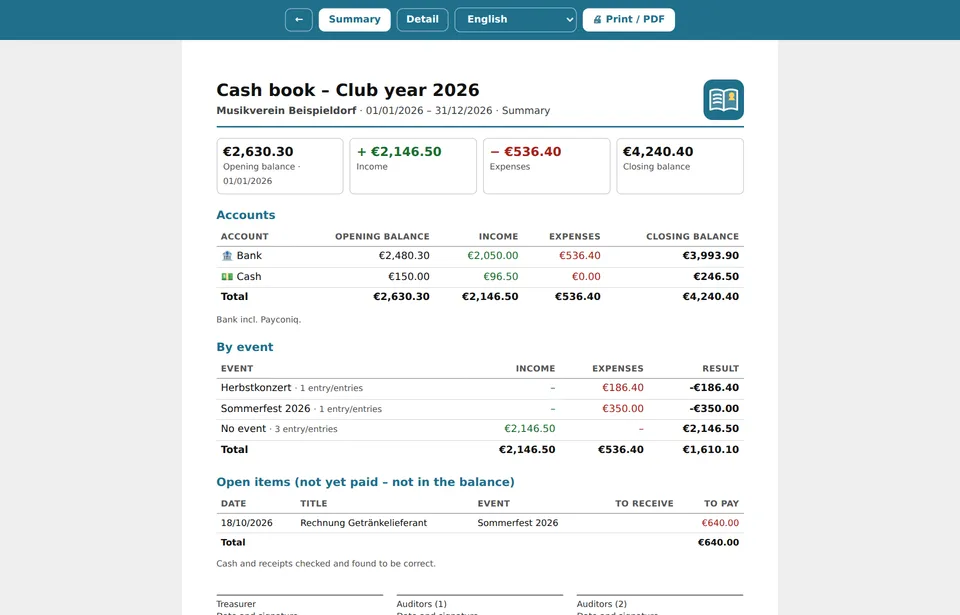
For the audit you print the cash book as a summary or in detail, also as a PDF. The summary shows opening and closing balance per account, the result per event and open items, plus a line confirming the check and signature fields for the treasurer and two auditors. If the auditors prefer their own spreadsheet, give them the CSV export.
There is no special auditor login with read-only rights. The usual way is the printout together with the receipts; if you want the auditors to look inside the app, an admin can add them temporarily on the committee and permissions page and remove their access afterwards. Veräinsbuch is a simple club cash book, not double-entry accounting. Pro costs €14.95 a month for the whole club, Basis €9.95, and the 14-day trial includes everything.
Simple pricing
Per club, no matter how many members. Cancel any month.
Basis · 9,95 € / month
- Tasks & reminders
- Meeting minutes
- Events & polls
- Inventory
- Members, helpers & contacts
- Push, offline, 5 languages
- 500 MB storage included
Pro · 14,95 € / month
- Everything in Basis
- Cash & expenses with receipt scan
- Cash book & balance per event
- Bank statement import
- Cash count & payment proofs
- 1 GB storage included
Everything is unlocked during the 14-day trial. Then choose Basis or Pro – or simply stop. More storage if needed: +5 GB for €1.95 a month.
Frequently asked questions
How many auditors does a club need?
Two is common, so nobody checks alone and one can stand in if the other is ill. The exact number, term of office and any reserves are set by your constitution or rules and by national law.
Can a committee member audit the books?
No. Auditors should be independent of the people whose work they check, so committee members and the treasurer’s close family are best avoided.
Do auditors have to check every receipt?
Not necessarily. In a small club a full check is realistic; otherwise use a reasoned sample that includes all larger amounts, and explain the method in the report.
What if the books do not balance?
Find the cause with the treasurer first. If a difference remains, the auditors describe it in their report and may recommend postponing approval until it is cleared up.
Do the auditors judge whether spending was sensible?
Usually they check that records are complete and that spending was authorised. Whether they also comment on value for money depends on your constitution and what the members asked of them.
Do auditors get their own login in Veräinsbuch?
There is no dedicated auditor role. Most clubs give them the printed cash book with receipts or a CSV export; alternatively an admin adds them temporarily and removes their access after the audit.