 Veräinsbuch
Handing over a club role: a checklist for new officers
The election is over, everyone is relieved – and a few weeks later the new treasurer asks where last year’s bank statements are. When officers change, knowledge disappears quickly: files sit on private laptops, passwords live in one person’s head and keys end up in someone else’s drawer. This page explains what to pass on and when, what to watch out for with the bank and any registry, and which mistakes are typical. At the end there is a checklist you can copy.
Published · David Bohler
Try free for 14 daysNo credit card needed · ready in 2 minutes
Why handovers so often go wrong
In many clubs one person has held a role for years. What they know is written down nowhere: which supplier gives a discount, when the insurance renews, who has the key to the equipment shed. When they step down, often with relief, that knowledge goes with them – not out of bad will, but because nobody thought to ask.
A good handover is therefore not a formality but a small project with a list, a date and someone responsible. It ideally starts before the election and only ends when the new people have every login and the old ones no longer do.
Timeline: before, at and after the election
- A few weeks before the AGM: outgoing officers gather papers, logins and open issues.
- At the meeting: record the result with names, roles and start of term in the minutes.
- Within two weeks: a handover meeting for each role, with papers and keys signed for.
- Within the deadlines that apply in your country: notify any registry, authority and the bank.
- After about three months: a short follow-up – what is still missing, what was unclear?
Chair: what to hand over
- The current constitution or rules and any standing orders
- Minutes of recent general and committee meetings, with decisions still to be carried out
- Contracts: rent or lease, insurance, membership of the umbrella body, maintenance
- Contacts at the council, governing body, sponsors, partner clubs and service providers
- Ongoing projects and promises the club has made
- The yearly plan with recurring dates and deadlines
Treasurer: what to hand over
A clean break matters most for the money. Ideally the change happens at the end of the financial year, after the audit. If that is not possible, record every balance on handover day and count the cash together.
- The cash book with a closing balance per account, which becomes the new treasurer’s opening balance
- Receipts and statements from previous years, kept for as long as your record-keeping rules require
- Cash in hand, counted and signed for, plus any floats used at events
- A list of unpaid bills, expenses not yet refunded and grants still to come
- Standing orders, direct debits paid by the club and payment dates through the year
- Any tax or grant paperwork the club has
Secretary: what to hand over
- The member list with contact details and notes on consent (data protection)
- Templates for notices and minutes, plus the minutes archive
- Postal address, PO box and any mail forwarding
- Logins for club email addresses, website, social media and group chats
- Official documents such as registry extracts, amended constitutions and lists of officers
Handover checklist (copy and use)
Use one copy per role. Both the outgoing and incoming officer sign at the end, so it is clear later what was passed on and when.
Handover checklist – [Club name]
Role: [Chair / Treasurer / Secretary / …]
Handed over by: [Name]   to: [Name]
Elected on: [Date]   Handover on: [Date]

1. Documents
[ ] Constitution/rules, current version
[ ] Minutes of the last [2] years, open decisions marked
[ ] Registry extract / list of officers / confirmation of filing
[ ] Contracts: [lease, insurance, governing body, maintenance …]
[ ] Files: location / link: [ … ]

2. Money (when the treasurer changes)
[ ] Cash book closed on [Date]
[ ] Closing balance current account: [0.00]   savings: [0.00]
[ ] Cash counted together: [0.00]
[ ] Unpaid bills and expenses: [list]
[ ] Standing orders and due dates: [list]
[ ] Bank mandate: old signatories removed, new ones added on [Date]
[ ] Bank cards and security devices handed over or cancelled

3. Logins and passwords
[ ] Club email accounts: password changed on [Date]
[ ] Website / domain / social media: [list]
[ ] Club app: permissions given to new officers, old ones adjusted
[ ] Group chats: admin rights transferred
[ ] Online accounts with suppliers, governing body, council: [list]

4. Keys and equipment
[ ] Keys: [clubhouse, store, letterbox, safe] – number: [ ]
[ ] Inventory up to date, location of [marquee, benches, PA system]
[ ] Items on loan: [to whom, until when]

5. Contacts and know-how
[ ] Key contacts: council, governing body, sponsors, suppliers
[ ] Year planner with recurring dates and deadlines
[ ] Ongoing projects and promises: [list]
[ ] “What I wish I had known earlier”: [notes]

6. Formalities
[ ] Election recorded in the minutes (names, roles, start of term)
[ ] Registry/authority notified on [Date] – check your constitution and local rules
[ ] Bank, insurer, governing body and council informed

Open points after handover:
[ … ]

[Place], [Date]

Handed over: ______________________   Received: ______________________
Formalities: registry, bank, insurance
Depending on the country and the legal form of your club, a change of officers may have to be reported to a registry, a regulator or a public authority, or published in an official journal. The form, the deadlines and who has to sign differ a lot. Check your constitution and rules, and ask your governing body, an advice service or a lawyer if you are unsure.
Whatever the registry needs, the bank usually wants the minutes of the election and identification for the new signatories. Remove outgoing officers from the bank mandate promptly, so nobody keeps access years after leaving. A short note with the new contact names also helps your insurer, governing body and local council.
Passing on passwords safely
Do not post passwords in the group chat. Hand them over in person and let the new officer change them straight away. Wherever possible, accounts should be registered to a club address rather than the chair’s private email. Then the next handover only needs a new password instead of moving the whole account.
Keep a short list of every login, without the passwords themselves: which service, which address, who has access. That list belongs with the club’s papers and makes every future handover easier.
Typical handover mistakes
- The handover is put off until the outgoing officer can no longer be reached.
- The old treasurer’s closing balance and the new opening balance do not match.
- A former treasurer is still on the bank mandate months later.
- Photos, minutes and member lists stay on a private computer.
- Nobody knows which contracts renew automatically.
- The registry is never told, so old names stay on the official record.
With Veräinsbuch the knowledge stays in the club
In Veräinsbuch the data belongs to the club, not to one person. Meeting reports, tasks, events, contacts with contracts attached and the inventory with storage locations all stay put when the committee changes. Under official documents you store the constitution, registry extracts or the list of officers with a date; for each type the newest one is marked as current and older versions stay available.
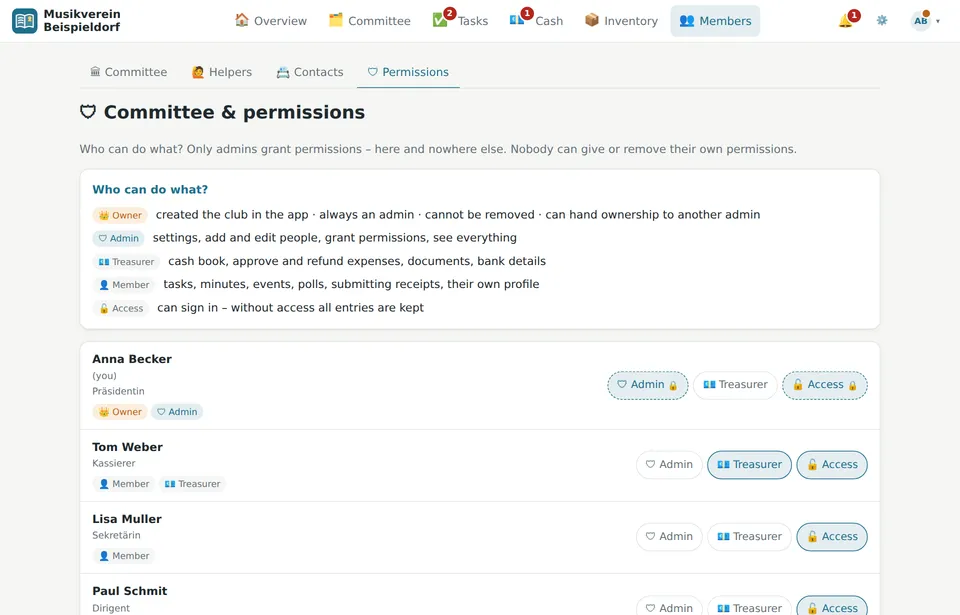
On the committee and permissions page, admins grant the admin and treasurer rights and switch access on or off. Someone who steps down loses access, but everything they entered is kept. The owner, the person who created the club in the app, is always an admin and can hand ownership to another admin – useful when the founding chair retires. With the Pro plan, the new financial year in the cash book starts from its opening balance, so the incoming treasurer can follow the money from day one.
The app does not file anything with a registry or bank for you; it keeps the papers you need for that within reach. Basis costs €9.95 a month and Pro with the cash book €14.95, each for the whole club. You can try it free for 14 days.
Simple pricing
Per club, no matter how many members. Cancel any month.
Basis · 9,95 € / month
- Tasks & reminders
- Meeting minutes
- Events & polls
- Inventory
- Members, helpers & contacts
- Push, offline, 5 languages
- 500 MB storage included
Pro · 14,95 € / month
- Everything in Basis
- Cash & expenses with receipt scan
- Cash book & balance per event
- Bank statement import
- Cash count & payment proofs
- 1 GB storage included
Everything is unlocked during the 14-day trial. Then choose Basis or Pro – or simply stop. More storage if needed: +5 GB for €1.95 a month.
Frequently asked questions
When should the handover take place?
Ideally within two weeks of the election, while everyone is available and motivated. The outgoing officer should start preparing before the meeting.
Does a change of officers have to be registered?
That depends on your country, legal form and constitution. Often a registry or authority must be told, with its own deadlines and formalities. Check your constitution and rules and take advice if needed.
What should an outgoing treasurer hand over?
The cash book with closing balances, receipts and statements, the counted cash, a list of open items and standing orders. The bank mandate must also be updated.
How do we pass on passwords safely?
In person rather than by chat, and the new officer changes the password at once. Ideally accounts are registered to a club address so they never have to be moved.
What happens to a former officer’s entries in Veräinsbuch?
An admin removes their access. Their tasks, meeting reports and cash book entries remain in the club.
Can the owner of the club account change in Veräinsbuch?
Yes. The owner can hand ownership to another admin and remains an admin until someone changes that.