 Veräinsbuch
Committee meeting agenda template for clubs and associations
A board meeting without an agenda runs longer and more often ends without a clear outcome. With a short, well-prepared list of items, everyone knows in advance what will be discussed, brings the right papers and leaves with decisions and names next to each action. Below you will find a sample agenda to copy, a step-by-step guide to preparing it, rough timings and the mistakes clubs make most often.
Published · David Bohler
Try free for 14 daysNo credit card needed · ready in 2 minutes
Why even a small board needs an agenda
In a village club the officers often meet in the clubhouse or around someone’s kitchen table, and much is settled informally. That is exactly when a short list helps: it stops the evening getting stuck on the first topic and gives quieter members a chance to raise their point. Anyone who cannot attend sees beforehand whether something important will be decided and can send their view in writing.
The agenda is also the skeleton of the minutes. If every item has a number and a purpose, the secretary only has to add what was discussed and agreed. For some decisions it may matter whether the topic was announced in advance, so check what your constitution or standing orders say.
Preparing the agenda step by step
- About ten days before: go through open action points and decisions from the last minutes.
- Collect topics: officers submit items by a fixed deadline.
- For each item, note who introduces it and what it should end with: information, discussion or a decision.
- Attach the papers: quotes, cost estimates, drafts, so nobody reads them for the first time at the table.
- Set the order: important and urgent items first, while everyone is still fresh.
- Estimate the time per item and compare the total with the planned finish.
- Send the notice and agenda about a week ahead and ask for apologies from anyone who cannot come.
Board meeting agenda template (copy and adapt)
Paste this sample into an email, a document or your club app. Replace everything in square brackets, delete items you do not need and adjust the timings.
Notice and agenda
Committee meeting – [Club name]

Date: [Day, DD Month YYYY]
Start: [7.30 pm] – planned finish: [9.30 pm]
Venue: [Clubhouse / address]
Chair: [Name]   Minutes: [Name]
Invited: [Committee members]
Guests for item [no.]: [Name, role]

1.  Welcome, attendance, apologies, quorum (5 min)
2.  Approval of the agenda, any additions (3 min)
3.  Minutes of the last meeting on [Date] (5 min)
4.  Action points from the last meeting – quick update (10 min)
    – [Action] – [Name] – done / open until [Date]
    – [Action] – [Name] – done / open until [Date]
5.  Treasurer’s update: balances, larger income and spending since last time (10 min)
6.  [Main topic, e.g. summer fair on DD/MM] (25 min)
    Purpose: [decision on budget and volunteer rota]
    Introduced by: [Name]
    Papers: [quote, cost estimate – attached]
7.  [Second topic, e.g. buying a marquee] (15 min)
    Purpose: [first discussion / decision]
    Introduced by: [Name]
8.  Reports from teams and sub-groups (10 min)
    – [Youth section] – [Name]
    – [Equipment/store] – [Name]
9.  Dates and deadlines until the next meeting (5 min)
10. Any other business – information only, no decisions (5 min)
11. Date and place of the next meeting (2 min)

Please let us know by [Date]:
– apologies to [Name]
– additional items to [Name]
Papers for item [no.] are attached.
Standing items and changing topics
Part of the agenda is the same every time: welcome, last minutes, progress on action points, a quick look at the money, upcoming dates and any other business. These standing items give structure and make sure nothing is quietly dropped. Keep them short on purpose; the treasurer’s update does not need fifteen minutes if the figures went out beforehand.
Between them sit one to three topics that really matter this time. More than three big subjects is too much for most volunteer boards in one evening. Whatever does not fit is deliberately moved to the next meeting or handed to a small working group that comes back with a proposal.
Timing: a realistic evening
Two hours is the limit for most club boards; after that, concentration drops noticeably. Write an estimated length next to every item and add them up. If the total does not match the planned finish, cut items while preparing, not at half past ten.
The chair keeps an eye on the clock without silencing every contribution. A simple line works well: “We have five minutes left on this one – do we decide tonight or come back to it?” That keeps the tone friendly and the meeting moving.
Using “any other business” well
Any other business is handy for short announcements but easily becomes a back door for large, unprepared subjects. Agree that it is for information only, not decisions. If something weighty comes up, put it on the next agenda with papers and enough time.
After the meeting: following up decisions
A good agenda is wasted if the results fade away. For every item, record what was decided, who takes it on and by when. Send the minutes round within a few days while everyone still remembers what was meant.
At the next meeting, the progress check on action points comes near the top. People who know they will be asked for a short update in two weeks are more likely to get things done. Anything that stays open for months is reassigned or consciously dropped instead of travelling from meeting to meeting.
Common agenda mistakes
- The notice arrives the day before and the papers only appear at the table.
- Items are called “fair” or “equipment” with no hint of what needs deciding.
- Too many big subjects for one evening, so the last ones are always postponed.
- Nobody asks about the action points from last time.
- A decision is taken under any other business that nobody had prepared for.
- Venue, start time or the person taking minutes were never fixed.
Agendas and minutes in Veräinsbuch
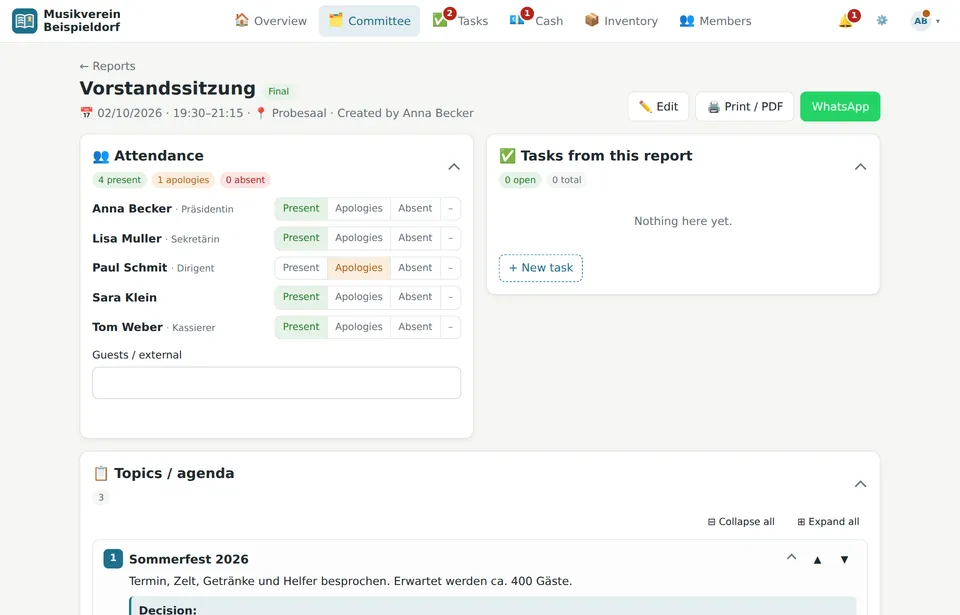
In Veräinsbuch each meeting gets a report. You enter the agenda items beforehand; during the meeting you tick off attendance and write the decisions under each item. Tasks are created right at the item they belong to, with a responsible person, a due date and automatic reminders. The finished report can be printed or shared as a PDF.
For the next meeting, one click copies a report as the agenda for the next meeting, so the standing items are already there and you only add the new topics. Put the date in the club calendar, which can be exported to the calendar on everyone’s phone; if no date is fixed yet, run a quick poll. Reports, tasks, events and polls are part of the Basis plan at €9.95 a month for the whole club; Pro with the cash book is €14.95. Try everything free for 14 days with no credit card.
Simple pricing
Per club, no matter how many members. Cancel any month.
Basis · 9,95 € / month
- Tasks & reminders
- Meeting minutes
- Events & polls
- Inventory
- Members, helpers & contacts
- Push, offline, 5 languages
- 500 MB storage included
Pro · 14,95 € / month
- Everything in Basis
- Cash & expenses with receipt scan
- Cash book & balance per event
- Bank statement import
- Cash count & payment proofs
- 1 GB storage included
Everything is unlocked during the 14-day trial. Then choose Basis or Pro – or simply stop. More storage if needed: +5 GB for €1.95 a month.
Frequently asked questions
What should a board meeting agenda include?
Welcome and attendance, approval of the last minutes, progress on action points, a short financial update, the main topics with their purpose, upcoming dates, any other business and the date of the next meeting.
How far in advance should the agenda be sent?
About a week works well for most clubs. If your constitution or standing orders set a notice period, follow that.
Can decisions be made under any other business?
It is better not to. People who did not know the topic was coming could not prepare. Whether such decisions are valid depends on your constitution and rules, so check if in doubt.
How many topics fit into one meeting?
Besides the standing items, usually one to three larger subjects. Anything else goes on the next agenda or to a working group.
Who writes the agenda?
Usually the chair, often together with the secretary. Every officer should be able to add items before a set deadline.
Can I reuse last month’s agenda in Veräinsbuch?
Yes. You can copy a meeting report as the agenda for the next meeting; the standing items are carried over and you only add what is new.