 Veräinsbuch
AGM invitation template for clubs: sample notice with agenda and proxy
The annual general meeting (AGM) is the most important meeting of the year for any club or association: members hear what happened, approve the accounts, discharge the committee and elect a new one. It all starts with a clear invitation. Below you will find a complete AGM invitation template you can copy, a proxy form, a checklist with deadlines and the most common mistakes to avoid. Always check your own constitution or rules first, because they decide notice periods, quorum and voting.
Published · David Bohler
Try free for 14 daysNo credit card needed · ready in 2 minutes
What a good AGM invitation has to do
An invitation to the general meeting is more than a friendly reminder. In many clubs it is the formal notice that makes the meeting valid. If members are not invited in time, or if important items are missing from the agenda, decisions taken at the meeting can later be questioned. A good invitation therefore answers every practical question in advance:
- Who is inviting: the club’s name and the committee or chair, as set out in your constitution.
- What kind of meeting: ordinary annual general meeting or extraordinary general meeting.
- When and where: date, start time, full address, and whether people can join online.
- The complete agenda, with every item that will be voted on.
- Who may vote, and whether proxies (voting on someone else’s behalf) are allowed.
- Deadlines for proposals, motions and candidacies for the committee.
- Where members can see the documents beforehand, such as the accounts or proposed rule changes.
AGM invitation template (copy and adapt)
Copy the text below into an e-mail, a letter or your club app and replace everything in [square brackets]. Remove items that don’t apply to your club and add anything your constitution requires.
- Replace the agenda numbers with your own order, but keep accounts and discharge before the elections.
- If the constitution is changed, name the article and attach the proposed wording.
[CLUB NAME]
[Address of the club]

[Place], [date of sending]

Invitation to the Annual General Meeting [year]

Dear members,

On behalf of the committee, we are pleased to invite you to the Annual General Meeting of [club name], which will take place on

[weekday], [date] at [time]
at [venue, full address]
[optional: Online participation via: [link]]

Agenda

1. Welcome and opening by the chair
2. Confirmation that the meeting was properly called and is quorate
3. Approval of the agenda
4. Approval of the minutes of the last general meeting of [date]
5. Annual report of the chair / secretary for [year]
6. Treasurer’s report for the financial year [year]
7. Report of the auditors (account examiners)
8. Approval of the accounts and discharge of the committee
9. Budget and membership fee for [next year]
10. Elections
    a) committee members: [number] seats ([names of members whose term ends])
    b) auditors for [next year]
11. Proposals from members and from the committee
    [list any proposal that will be voted on, e.g. change to the constitution, Article [x]]
12. Activity programme for [next year]
13. Any other business (no votes)

Proposals and candidacies
Proposals for the agenda and candidacies for the committee must be sent in writing to [name, e-mail or address] by [date] at the latest.

Voting rights and proxies
All members [aged [x] and over / who have paid their membership fee for [year]] are entitled to vote. A member who cannot attend may give a written proxy to another member. Each member may hold no more than [number] proxy/proxies. Please bring the signed proxy form to the meeting or send it to [name] beforehand.

Documents
The annual accounts and the proposals will be available from [date] at [place / link / on request from the secretary].

The meeting will be followed by [a drink / a meal / a small reception]. To help us plan, please let us know by [date] whether you will attend.

We look forward to seeing you.

On behalf of the committee

[Name]                         [Name]
Chair                          Secretary
Proxy form template
If your constitution allows proxy voting, attach a short proxy form to the invitation. It saves discussions at the door and makes it easy to count votes. If your rules do not allow proxies, leave this part out completely.
PROXY – Annual General Meeting of [club name] on [date]

I, the undersigned, [first name, last name], member of [club name],

authorise [first name, last name of the proxy holder], also a member of the club,

to represent me at the Annual General Meeting on [date] and to vote on my behalf on all items of the agenda.

[Optional: My voting instructions: item [x]: for / against / abstain]

[Place], [date]

Signature: ______________________
Notice periods and how to send the invitation
How far in advance you have to invite, and in what form, is usually written in your constitution or rules. Many clubs use two to four weeks; some require a letter, others allow e-mail or a notice in the club newsletter. Look this up before you plan anything, because it decides the latest possible sending date. If your rules say nothing, choose a period that gives everyone a fair chance to plan, and use the same method every year.
Keep proof of when and how you invited members: a copy of the e-mail with the date, a list of addresses or a post on your club platform. If someone later says they were not invited, you can show what you did. Members without e-mail should get the invitation in the way your rules foresee, for example by post.
Building the agenda: what belongs on it
Members can usually only vote on items that were announced on the agenda. That is why the agenda deserves the most care. A typical AGM agenda follows a logical order: first look back, then decide on the past year, then look ahead.
- Formalities: opening, quorum, approval of the agenda and of the last minutes.
- Reports: chair or secretary, treasurer, auditors, and any sections or teams.
- Decisions on the past: approval of the accounts and discharge of the committee.
- Elections: committee members whose term ends, auditors for the next year.
- Decisions on the future: budget, membership fee, rule changes, larger projects.
- Any other business: for information and questions only, no binding votes.
Proposals, motions and elections
Set a clear deadline for proposals and candidacies in the invitation, and say who should receive them. If a proposal changes the constitution, many rules require the exact wording to be announced in advance and a special majority to approve it. Ask your committee to check this early; an extraordinary general meeting just to repeat a vote costs everyone time.
For elections, list which seats are up and who is standing down. Ask members in advance who would like to stand; a meeting where nobody wants to be treasurer is much easier to handle if you know it a month before.
Checklist: preparing the AGM step by step
- 8 weeks before: fix the date with the committee and book the venue.
- 6 weeks before: check notice period, quorum and voting rules in the constitution.
- 5 weeks before: ask the treasurer for the accounts and the auditors for their check date.
- 4 weeks before: send the invitation with agenda and proxy form.
- 2 weeks before: deadline for proposals and candidacies; make the documents available.
- 1 week before: prepare the attendance list, ballot papers and the chair’s script.
- On the day: count present members and proxies, and appoint a minute-taker.
- After the meeting: write the minutes and share them within a few weeks.
Common mistakes with AGM invitations
- Sending the invitation too late, so the notice period in the constitution is not respected.
- Forgetting items that need a vote, such as the membership fee or a rule change.
- Only writing “elections” without saying which positions are up.
- No deadline for proposals, so new topics appear at the meeting itself.
- Unclear proxy rules: who may hold a proxy, how many, and in what form.
- Keeping no record of when and how members were invited.
- Copying last year’s invitation without updating dates, years and names.
How Veräinsbuch helps with the AGM
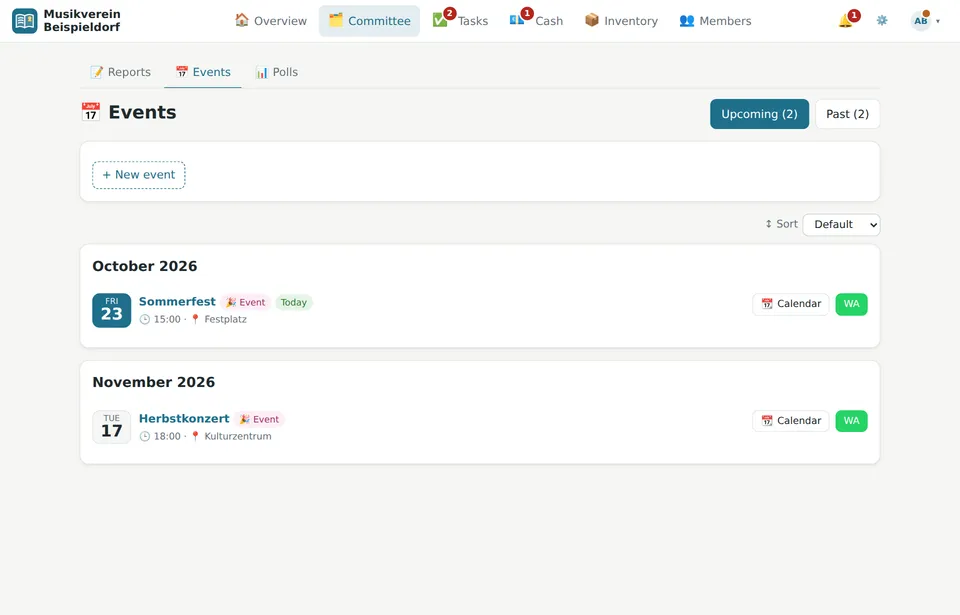
Veräinsbuch is not a legal tool and does not replace your constitution, but it takes a lot of the organisation off the committee’s shoulders. You can find a date with the committee using a poll, create the AGM as an event with an invitation, and members see it in the shared club calendar and on their phone. Preparation becomes a list of tasks with deadlines and reminders, so the venue, the accounts and the ballot papers are not forgotten.
Your constitution and other official documents can be stored with their date, so everyone uses the current version. On the day, record the meeting in the minutes with agenda, attendance and decisions, and share the result as a PDF. With the Pro plan, the treasurer prepares the cash book and the balance per event for the treasurer’s report and exports everything as PDF or CSV for the auditors.
What it costs
Events, polls, tasks and minutes are included in the Basis plan at €9.95 per month per club, whatever the number of members. Pro at €14.95 per month adds the cash book, receipt scan, cash counting and payment receipts. The 14-day trial is free, includes all features and needs no credit card; after that you can cancel monthly.
Simple pricing
Per club, no matter how many members. Cancel any month.
Basis · 9,95 € / month
- Tasks & reminders
- Meeting minutes
- Events & polls
- Inventory
- Members, helpers & contacts
- Push, offline, 5 languages
- 500 MB storage included
Pro · 14,95 € / month
- Everything in Basis
- Cash & expenses with receipt scan
- Cash book & balance per event
- Bank statement import
- Cash count & payment proofs
- 1 GB storage included
Everything is unlocked during the 14-day trial. Then choose Basis or Pro – or simply stop. More storage if needed: +5 GB for €1.95 a month.
Frequently asked questions
How much notice do we need to give for an AGM?
That depends on your constitution or rules, which usually set the notice period and the form of the invitation. Many clubs use two to four weeks. If you are unsure, check the rules and ask for advice before you send the invitation.
Can we send the AGM invitation by e-mail?
In many clubs, yes, if the constitution allows it or does not require a specific form. Keep a copy with the sending date, and make sure members without e-mail are invited in the way your rules require.
What must be on the agenda of an annual general meeting?
Typically the reports of the chair, treasurer and auditors, approval of the accounts, discharge of the committee, elections, the membership fee and any proposals that will be voted on. Your constitution may add more items.
Can members vote by proxy?
Only if your constitution or rules allow it. If they do, state the rules in the invitation, such as how many proxies one member may hold, and attach a proxy form like the template above.
What is the difference between an ordinary and an extraordinary general meeting?
The ordinary general meeting takes place regularly, usually once a year, to approve the accounts and elect the committee. An extraordinary general meeting is called for a specific reason, such as a rule change or an urgent decision, as provided for in your constitution.
Does Veräinsbuch send the invitation for us?
You can create the AGM as an event with an invitation in Veräinsbuch, and members see it in the club calendar and on their phone. Whether that counts as formal notice depends on your constitution, so many clubs also send the invitation text above by e-mail or post.